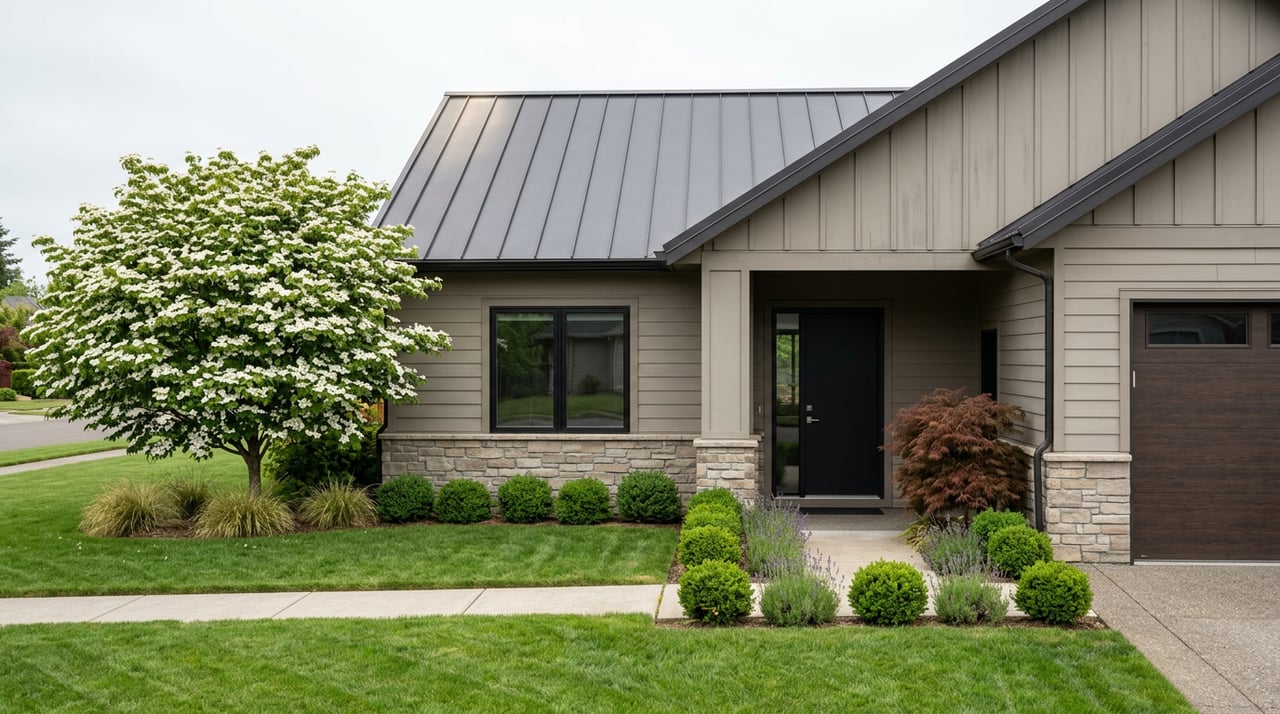
The Medford Water Right Isn't a Fixture. It's a Queue Position.
September 3, 2026
September 3, 2026
Somewhere in the middle of a Medford disclosure packet, usually a page or two past the roof and the furnace, sits a small section labeled Irrigation. Most buyers skim past it the way they skim past the seismic hazard checkbox. It looks like paperwork about a sprinkler timer. On a good number of lots east and south of downtown, on streets like Orchard Home Drive, Coker Butte Road, and the older parcels off Delta Waters Road, that checkbox is describing something else entirely: a legal claim to water delivered through a century-old canal system, one that in 2026 ran out weeks before it was supposed to.
That's the part nobody explains until escrow. An irrigation water right attached to a Medford property isn't owned the way a fence or a patio is owned. It's a place in a queue, administered by a district board, filled from reservoirs that depend on snowpack, and it can be shortened, delayed, or shut off entirely in a bad year. 2026 was a bad year. Understanding why matters whether you're buying a home that comes with one of these rights or selling one and trying to explain what it's actually worth.
Medford's irrigated lots trace back to an early-1900s land promotion push, when a Spokane investor named Pat Welch bought out the Fish Lake Company's water system, subdivided orchard land, and sold parcels for $200 to $300 an acre. That system eventually split into three separate districts that still operate today: Medford Irrigation District (MID), Rogue River Valley Irrigation District (RRVID), and Talent Irrigation District (TID). Between them they still irrigate roughly 35,000 acres across Medford, Phoenix, Talent, and Ashland, delivered through infrastructure like the Hopkins Canal and the Cascade Canal, and stored in reservoirs including Fish Lake, Fourmile Lake, and Emigrant Lake.
A street literally named Orchard Home Drive is not a coincidence. It's a fossil of that history, a marker that the land underneath it was once irrigated agricultural ground before it became residential. Some of those parcels kept their water rights when they were converted to house lots. Others didn't, for reasons that matter a lot at closing and that most buyers never ask about.
Oregon's 2025-26 winter tied 1934 as the warmest on record, and the record-low snowpack that followed left Jackson County at 95 percent moderate to severe drought as of April 7, 2026. That triggered a state drought emergency for the county under Executive Order 26-07, one of nine Oregon counties under emergency status by late April.
"Communities across the state are being confronted with unprecedented drought conditions."
That was Governor Tina Kotek's assessment when she signed the order. For the three irrigation districts that supply Medford-area lots, the practical translation showed up in the water itself. MID's allocation out of Emigrant Reservoir sat at just 21.7 percent of a normal year's allotment as of June 1, 2026. Medford Irrigation District and Rogue River Valley Irrigation District have already ended their 2026 seasons early after depleting their water supplies, and Talent Irrigation District has announced it will shut down its entire system on September 4, just days from now, after exhausting its share of Emigrant Lake.
| District | Area served | Key infrastructure | 2026 season |
|---|---|---|---|
| Medford Irrigation District (MID) | Medford and surrounding parcels | Hopkins Canal, Cascade Canal, storage in Fish Lake and Fourmile Lake | Ended early; Emigrant allocation at 21.7% of normal as of June 1 |
| Rogue River Valley Irrigation District (RRVID) | Medford area, Agate Reservoir lands | Agate Reservoir, shares the Little Butte Creek system with MID | Ended season early amid drought |
| Talent Irrigation District (TID) | Medford, Phoenix, Talent, Ashland | Emigrant Lake, Howard Prairie Reservoir, Hyatt Reservoir | Full system shutdown announced for September 4 after exhausting Emigrant Lake supply |
That's the number that should reframe how a buyer reads the word "irrigation" on a disclosure form. It's not a fixed utility like city water. It's a share of a shared, weather-dependent supply, and in a year like 2026, that share can run out before the growing season is over.
Oregon law puts a specific obligation on sellers here. Under ORS 537.330, if you're selling land that includes any portion of a water right, you're required to tell the buyer in writing, once an offer is accepted, whether the permit, transfer approval order, or certificate evidencing that right actually exists and is available. If it is, you have to hand it over at closing. This sits alongside the standard OREF Seller's Property Disclosure Statement, which has its own dedicated Irrigation section separate from household water.
In practice, this means a seller can't just tell a buyer "yes, it has water rights" as a selling point and leave it there. The paperwork has to exist, and it has to move with the sale in writing. If it doesn't exist, or the seller can't produce it, that's a conversation to have before the property goes under contract, not after.
Here's the part that catches people off guard. A water right inside one of these districts doesn't transfer just because the deed does. MID's own rules state plainly that no water right may be transferred from land on the district's assessment roll without prior written district approval, and that approval is subject to the board's discretion. Neither the district nor the landowner can act unilaterally, because both hold an interest in how that water gets used.
That approval process comes with real costs. As of MID's current fee schedule, taking a water right off a parcel runs $399 per tax lot plus a $110 GIS mapping fee. Adding a water right to land that doesn't have one costs more: a $550 application fee, another $110 GIS fee, and $2,000 per acre to the district to build the physical turnouts needed to deliver the water. None of that is optional paperwork you can skip by just recording a new deed.
There's a second trap that's easy to miss, and it runs the other direction. Oregon law requires that when formerly irrigated land is platted into a subdivision at a density of three or more lots per acre, the water right has to be transferred off that land and the parcel excluded from the district. This happens automatically as a condition of platting, often years before a given lot changes hands.
So a buyer looking at a newer infill lot on a street with orchard-era roots, assuming it must carry a water right because of the neighborhood's history, may be wrong. The right was stripped at the subdivision stage, long before the current owner bought in. The reverse mistake happens too: a buyer assumes a lot has no water right simply because it's a modern-looking home, when in fact the parcel predates the subdivision cutoff and the right is still attached and unassessed for years.
Does every home in Medford with mature landscaping have an irrigation water right? No. Only parcels that remain appurtenant to a water right within MID, RRVID, or TID boundaries, and that haven't been excluded through subdivision, carry one. Mature trees and lawns can exist on city water alone.
What happens if a previous owner didn't pay the irrigation assessment? Under MID's published rules, an account unpaid by May 1 gets a lien placed on the property for the current and prior year's charges, plus a $500 lien fee. After three consecutive unpaid years, the account moves to the district's attorney for foreclosure proceedings. That's a lien history worth checking before closing, not after.
Will a shortened season like 2026's happen every year going forward? Nobody can promise that. What's documented is that Oregon's 2025-26 winter tied 1934 for warmest on record, snowpack hit a record low for the date, and state hydrologists have said conditions could mean smaller irrigation district allotments becoming more common rather than less.
If you're weighing a Medford property that lists an irrigation right, or trying to figure out what one attached to your own lot is actually worth at sale, that's exactly the kind of detail worth working through before you list or write an offer. Mayra Valencia works with buyers and sellers across the Rogue Valley on the parts of a transaction that don't show up on a listing photo. Let's Connect.
Stay up to date on the latest real estate trends.


Experience strategic negotiation, clear communication, and expert guidance at every stage of your real estate journey. Whether buying, selling, or relocating, you can expect dedicated representation and results delivered with integrity.